










Making Cotton Learning Journey
Cotton is not made; it is a plant which grows in warmer parts of the world. Cotton plants have yellowish pink flowers which bloom very briefly. The seed bearing part of the plant is known as the boll and it is this which is picked to make cotton. For thousands of years cotton has been harvested, cleaned, spun, woven, bleached and dyed to make an astonishing variety of different items.
Click on the steps below to learn about cotton through history, cleaning and carding, spinning, weaving, bleaching and dyeing.
Click on the steps below to explore.
 |  |  |  |  |  |
|
Making Cotton Learning Journey Step 6: Dyeing
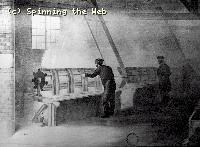
Persia, India, China, Egypt and Phoenicia (modern day Lebanon) were skilled in dyeing and printing techniques centuries before the birth of Christ. Phoenicians were renowned for their brilliant purple dyes and their name may derive from the Greek word for purple. Winding sheets from Egyptian mummies show traces of the use of madder and indigo. Indian cottons are still prized for their bright colours. The arts of dyeing enjoyed a renaissance in 14th century Italy and Dyers Guilds were formed in Florence and Venice. The discovery of America in 1492 and Brazil in 1500 by the Spanish and Portuguese respectively led to a number of new dyestuffs for textiles being introduced. Before the advent of the Industrial Revolution in the 18th century and discovery of artificial or aniline dyes during the 19th century, dyeing was done by natural methods using the flowers, berries, leaves, barks and roots of plants and herbs. Some common sources for natural dyes: red: madder (root); meadowsweet (root) yellow: weld; bog myrtle; marsh marigold; golden rod blue: woad (leaves); elder (berries); cornflower green: nettles (roots, stalk, leaves); lily of the valley; bracken (buds) purple: deadly nightshade; elder (berries); dandelion (root) brown: blackthorn; larch (needles); onion (skins) black: blackberry (shoots);alder (bark);oak (bark/acorns); water lily (root) See also on this website: Industry: machines and processes - finishing Contact Quarry Bank Mill at Styal in Cheshire for information on courses in making and using natural dyes. 01625 527468 GG |
 | |
| Associated Objects | |
| |
| Related Narratives | |
| |