










Making Cotton Learning Journey
Cotton is not made; it is a plant which grows in warmer parts of the world. Cotton plants have yellowish pink flowers which bloom very briefly. The seed bearing part of the plant is known as the boll and it is this which is picked to make cotton. For thousands of years cotton has been harvested, cleaned, spun, woven, bleached and dyed to make an astonishing variety of different items.
Click on the steps below to learn about cotton through history, cleaning and carding, spinning, weaving, bleaching and dyeing.
Click on the steps below to explore.
 |  |  |  |  |  |
|
Making Cotton Learning Journey Step 4: Weaving
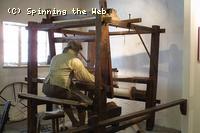
The first looms date back to the Neolithic (New Stone Age) which began around 8,000 B.C. and, in England, didn't end until about 2,500 B.C. Weaving as a skill developed from the need for people to make warm protective body coverings (clothes and blankets) from the yarns they spun. Two early types of loom were the warp weighted loom and the horizontal loom. The warp weighted loom was made from wooden poles set into the ground as a rectangular frame and tied together. The warp (vertical) threads were tied to the top of the frame and the bottom ends of the threads were bunched together and secured with weights. The weaver stood in front of the frame to weave the weft (cross) threads through the warp threads. The horizontal ground loom worked in a similar way but the weaver laid out a pattern of sticks, measured according to the length and width of the cloth to be woven, and then drove them into the ground. The Chinese invented a more mechanised form of weaving known as a treadle and frame loom. In medieval times the draw loom was used for weaving complex patterns. A 'draw boy' sat on top of the loom raising and lowering heddles (sets of parallel cord used to separate the warp threads) individually for the weaver. The handloom, invented some 2,000 years ago, was brought to Britain by the Romans. In 1733, John Kay invented the flying shuttle which required the use of only one hand to knock the shuttle back and forth across the loom and doubled the speed of weaving. At first cotton yarn spun in the mills was woven on handlooms. The power loom was invented by Edmund Cartwright in 1785 and improved by William Horrocks in 1802. Timeline warp weighted loom Neolithic (c8,000-5,000 B.C. [2,500 B.C. in England]) horizontal ground loom Neolithic (c8,000-5,000 B.C. [2,500 B.C. in England]) treadle and frame loom Bronze Age in China (c4,500-800 B.C.) handloom Roman (c A.D. 43) draw loom c1400 AD power looms 1785 (Cartwright) and 1802 (Horrocks) See also on this website: Industry: machines and processes - weaving Contact Quarry Bank Mill at Styal in Cheshire for a tour of a working mill and information on weaving courses 01625 527468 |
 | |
| Associated Objects | |
| |
| Related Narratives | |
| |