







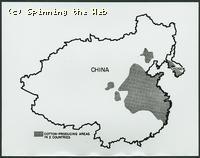
Until 1699 the English had to trade at one remove because China refused to allow 'foreign barbarians' into the country. The East India Company made much of its money at first from an inter Asian trade centred on Taiwan; but in 1699 the Company finally gained a foothold on the Chinese mainland at Canton. China is a large country with differing climates and grows its own cotton. Like Indian cotton, Chinese cotton has short staples and a dull coarse fibre. The country had its own cotton industry and China exported nankeen to England and other places. Nankeen is a 'sturdy yellow or buff cotton cloth' and nankeens are trousers made from this material. Chinese export of nankeen peaked in 1819 although English nankeen imports reached their peak in 1828. The Lancashire cotton goods trade did not make a profit selling to the Chinese in Canton until 1827 but by 1831 exports of British cotton to China had exceeded the imports of nankeen. However Lancashire cottons did not make the expected impact on Chinese markets. They were too light and too expensive for the market demands and they could not compete with local Chinese hand loom products. The Tai-Ping Rebellion of 1853-1864 in China at first caused trade to expand with Hong Kong and Shanghai but later declined as over 10% of the Chinese population were killed during the Rebellion. Despite this loss China rose gradually to become the second largest export market for English cottons, overtaking the USA in 1861, and coming second only to India by 1868. By this time the markets of the Yangtze Valley had been opened up. Lancashire calico became more competitive in price because USA cotton prices had dropped below that of Chinese cotton as a result of the American Civil War (1861-1865) and heavier sizing (stiffening of the cloth) had resulted in cheaper cloth. China responded to this assault on her cotton markets by taking advantage of low yarn prices between 1870-1900 to greatly increase yarn imports and concentrating on handloom weaving rather than its spinning industry. The handloom industry expanded from the cotton growing areas of south China to central and western China. The cloth produced provided cheap warm clothing for the Chinese without the need for heavy sizing and this severely restricted the expansion of the Lancashire calico trade in China. During the final decade of the 19th century China began to build her own cotton spinning mills to provide yarn for the handlooms to weave cloth. This enabled China to be far more self sufficient in the textiles market at the cost of the Lancashire cotton industry. From 1905 there was something of a 'cultural renaissance' in Asia. Japan was also becoming highly proficient in the production of textiles; and during the early 20th century China increasingly imported yarn and cotton piece goods from Japan. China, along with Japan and India, successfully challenged Lancashire's supremacy in the cotton industry by importing Lancashire yarn cheaply and then creating their own mechanised cotton industries. Today China is the biggest producer of raw cotton in the world. GG View the China collection to find out more > |
 | |
| Associated Images | |
| |
| Related Narratives | |
| |