









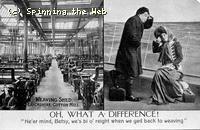
Rich gentlemen farmers could send their sons abroad (wars permitting), to do the grand tour, before settling down to their responsibilities, but most people would never travel beyond the confines of their own parish boundaries. That is not to say that people led lives of unending drudgery in the days before the factory, there were frequent festivals and holy days when fairs and markets would be held, giving people the chance to dress in their best finery and take part in dances and processions. For six days of the week the people would work but Sunday was a day of rest, when after the basic necessary chores were finished the people would attend church, and visit friends and relatives. Once a year the parish would hold special celebrations for their own church's patron saint, which were known as wakes after the practice of staying awake on the previous night, to keep a vigil for the saint. There were many holy days during the year, Easter, All Saints' Day, Christmas, add to these many ancient country festivals, Walpurgis / May Day the dual celebration of the pagan coming of spring with the Catholic Saint Valborg's day (although her saint's day is actually in February), when bonfires were lit to chase away the dark cold winter and herald the coming of the sun, and fertility dances were held to ensure the abundance of crops and animals. Midsummer's day, more bonfires and celebrations. Harvest home, (Lughnasadh) celebrating and giving thanks for a good crop, successfully harvested. Hallowe'en, the end of the agricultural year, when the world of the living was closer to the world of the dead and spirits roamed. Michaelmas, November 11th, when animals were slaughtered for the coming winter food and fairs took place. The factory system brought an abrupt end to most of these celebrations. Many people moved away from the countryside, forced to seek work in the towns after the enclosure of common land left them with no means of supporting themselves by agriculture. They found that the factory owners had little sympathy for the old ways, time was money in the factory, and Sunday was the only day allowed for rest. Church attendance was expected, women and children had household chores, for most people there was little or no leisure time. The 1833 Factory Act cut the amount of hours that children between the ages of 9 and 18 were allowed to work and stated that holidays for children and young persons were to be all day on Christmas Day and Good Friday, plus eight half days; These provisions were extended to women in 1844, with Saturday's quitting time set at 4.30 p.m. In 1847 the Ten Hours Bill introduced a 10 hour working day, or a 60 hour working week, for everyone over the age of 13, and the Factory Acts of 1867 and 1874 stated adults should not work on Good Friday or Christmas Day. The 1874 Act reduced the working week to 56½ hours which meant that many people had Saturday afternoons off as well as every Sunday. During the 1840s the first public parks were established; recreating a little of the countryside in the towns. Many were formed from land donated or bequeathed by local landowners, or on land unsuitable for other use. Phillips Park in Manchester and Queen's Park in Harpurhey both opened in 1846. The parks had paved or gravelled walks; green spaces for children to play; trees; flowerbeds; and usually a boating lake and a bandstand. Entry to these places was free and on fine Sunday afternoons families would usually go to the nearest park. Often there were concerts, and sometimes, in summer, open air theatre. There were also travelling fairs which the children loved. Cheap and efficient horse drawn omnibuses encouraged trips out to tea gardens in the villages surrounding Manchester, such as Northenden, Didsbury, Sharston, and Blackley. In 1871 bank holidays (on Easter Monday, Whit Monday, first Monday in August and Boxing Day) were introduced. The inexpensive expanding public transport system (trains and horse drawn buses) made travel possible for many people for the first time. Day trips to the countryside or the seaside became very popular. It was a relief for people to get out of the grimy cities. They could spend a day on the beach or in country fields, walk in the hills, or enjoy a family picnic. From the early 1870s Wakes Week, extended from the original celebration of a local saint's day, was a time when the mills closed down for a whole week and everyone had to take their week's holiday at the same time. Each town had its own Wakes Week. There would be travelling fairs and festive events, but cheap transport also meant that people could go away. At this time seaside holidays became very popular. Families saved all year to stay in a boarding house for a week. People thronged to towns like Blackpool and Southport. Special holidays were usually granted for events such as Coronation Day; special jubilee anniversaries (when the king or queen had been on the throne for 25, 50, or 60 years); or a royal wedding. Queen Victoria had jubilees in 1852, 1887 and 1897. In 1887 and 1897 there were street parties. Long tables were laid in the street for a celebration tea followed by games and dancing. The coronation of Edward VII and Queen Alexandra on 9th August 1902 was celebrated with a special public tea in most towns and villages. "Excursion clubs" were also organised in many workplaces so that employees could have an annual outing. One day a year would be set aside for a trip to the seaside or the country for which employees would save a small amount every week in the excursion club so that they (and perhaps their families) could enjoy a day out together with their workmates and have lunch and tea in a restaurant. Organisations like the "Happy Day Fund" would pay for a special day trip for orphaned, sick or very poor children. Sunday schools organised a day trip once a year for children who had attended regularly and collected their tokens to prove it. It was not until the late 1950s that working class people began to look further afield, and with the advent of package holidays, at first to Spain and then to more exotic locations, workers found they had more to look forward to for their two weeks a year than just a train excursion to Blackpool. SD View the Holidays & outings collection to find out more > |
 | |
| Associated Images |
|
| |
| Related Narratives |
Whitsuntide Whit Walks |
| |