









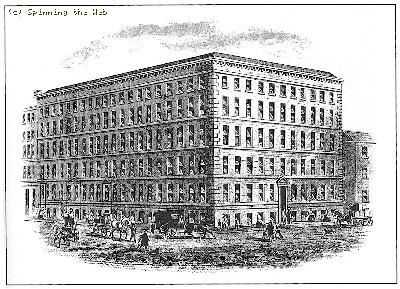
The number of cotton mills in Manchester reached a peak of 108 in 1853 - numbers then began to decline. Manchester, the trading centre of the global cotton market, was turning its back on the grimy factory. During the second half of the 19th century the dominant image of Manchester became the warehouse rather than the spinning mill. Johann Georg Kohl visiting Manchester in 1844 describes the scene: "Let us now turn into one of the by-streets which diverge from Market Street, into Mosley Street, or Cooper Street, for instance. Here stand the great warehouses, five or six stories high, all large and imposing, some of them stately and elegant. At night these warehouses are brilliantly lighted from top to bottom - there are people here, possessing annual incomes of thousands, who work like horses all the year round, stinting themselves in sleep and mealtimes, and grudging every moment given to amusement or society. Business is their habit and delight, their very existence" And at the centre of it all was the Royal Exchange: "the parliament of the cotton lords, as it is sometimes called. The Manchester Exchange is one of the handsomest and most spacious in England." (source: Johann Georg Kohl (1844 ) Journeys through England & Wales pp106-147) BB View the City Centre collection to find out more > |
 | |
| Associated Images | |
| |
| Related Narratives |
Cotton Trading City Centre |
| |

|